
In modern MDF, HDF, Particle Board and OSB production lines, material flow control is directly related to production stability, glue consumption and final board quality.
Wood particles, fibers or strands are continuously transferred between different processing sections. However, the material flow is not always constant. Changes in bulk density, moisture content, particle size and material level can cause fluctuations in the actual feeding rate.
For this reason, a Particle Belt Scale is an important component in modern material metering systems.
When combined with a Particle Dosing Bin / Metering Bin, the system can provide controlled material discharge, continuous weighing and stable feeding to downstream equipment.
HUATAO's metering belt solutions are designed for applications in MDF, particle board, OSB and other wood-based panel production lines.
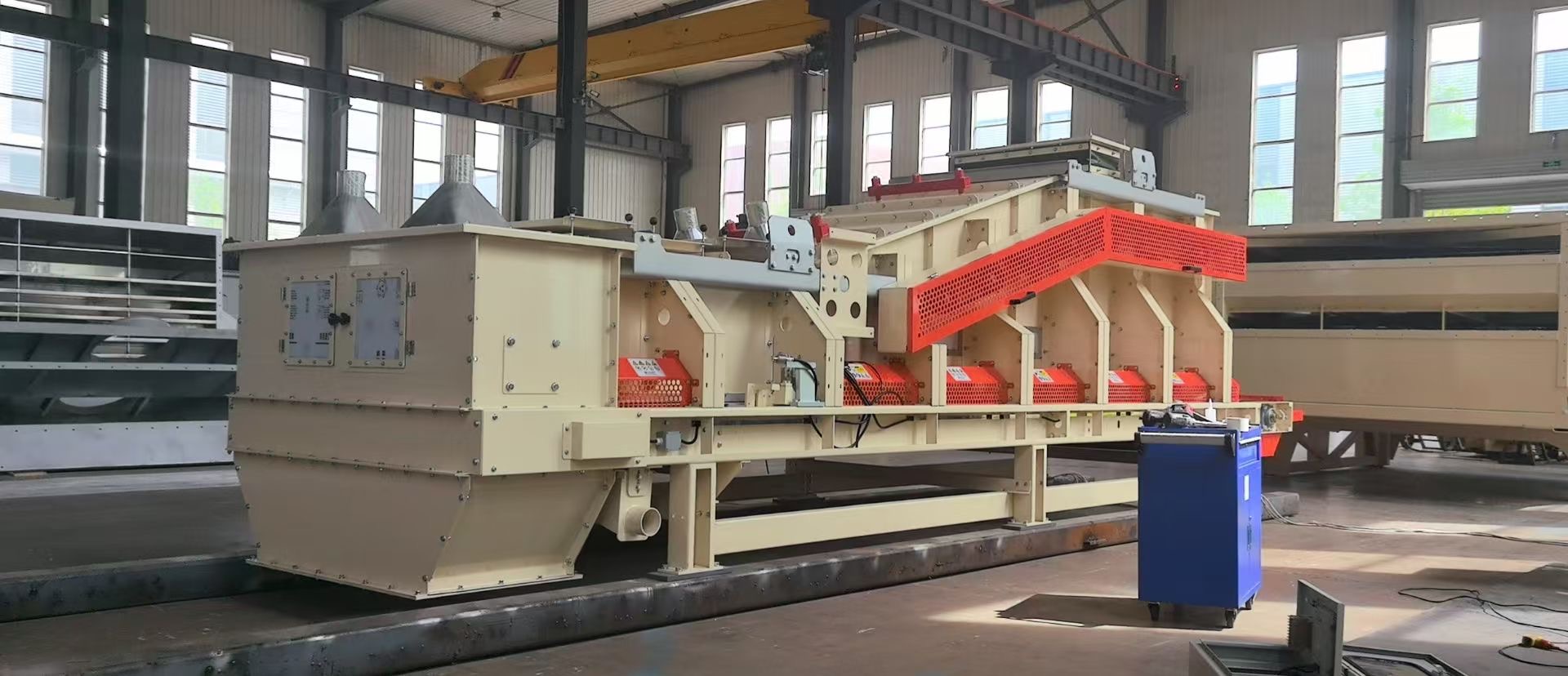
A Particle Belt Scale is a continuous weighing and conveying system used to measure the actual mass flow of bulk wood materials while they are transported on a belt.
Unlike a conventional conveyor belt, which mainly performs material transportation, a weighing belt provides an additional function:
Conveying + Continuous Weighing + Flow Monitoring + Metering
The material falls onto the belt from a dosing bin or hopper.
As the material passes through the weighing section, the system measures the material load on the belt while an encoder measures belt speed.
The control system can then calculate the instantaneous material flow.
In simplified terms:
Material Load on Belt × Belt Speed = Actual Material Flow
This allows the production control system to continuously monitor how much material is being supplied.
Belt scales are widely used to measure and control bulk-material flow, including applications where production recipes and material ratios need to be controlled.
These two terms are sometimes confused.
They are related, but they are not exactly the same component.
The Metering Bin / Dosing Bin is mainly responsible for:
The Particle Belt Scale / Weigh Belt is mainly responsible for:
Therefore, a complete system can be understood as:
Particle Storage → Metering Bin → Dosing Belt → Weighing Section → Controlled Material Flow
In wood-based panel production, dosing bins are used to buffer material flow between process stages, while the belt scale provides the actual throughput signal for downstream control.
The wood particles used in panel production are not always identical.
Their:
can change during production.
Even if the belt is running at a constant speed, the actual mass of material transported may change.
For example, a belt carrying material with a higher bulk density can transport significantly more material than the same belt speed carrying lighter material.
Therefore, belt speed alone cannot always represent actual material throughput.
This is why gravimetric measurement is important.
A Particle Belt Scale measures the actual material load and combines it with belt speed to determine the real-time flow rate.
Particle Board production requires controlled feeding of different particle fractions.
Typically, production may involve:
Surface Layer Particles
Core Layer Particles
Fine Particles
Coarse Particles
Different particle fractions may require different feeding rates.
A Particle Belt Scale can continuously monitor the actual material flow and provide feedback to the production control system.
This can help maintain a more stable material supply to:
A dosing bin and weighing belt combination is specifically used in wood-based panel applications to meter wet or dry particles.
MDF production mainly uses refined wood fibers.
Compared with larger wood particles, fibers are lighter and can have different flow characteristics.
This creates additional challenges for material metering.
Fine fibers can sometimes:
A well-designed metering system therefore needs not only a weighing function but also a stable feeding structure.
The combination of:
Metering Bin + Level Control + Dosing Belt + Weighing System
can help maintain a consistent fiber flow.
OSB production uses relatively large wood strands.
Compared with MDF fibers and conventional particle board particles, OSB strands have different dimensions, orientation and flow behavior.
Therefore, the metering system needs to accommodate:
Specialized metering systems for OSB can combine a storage/levelling area with a weighing section and belt-speed measurement to achieve controlled strand flow.
A complete Particle Belt Scale system normally includes several important components.
Stores the material before controlled discharge.
Helps distribute the material more evenly before it reaches the weighing section.
Depending on the design, this can include:
Such devices help reduce bridging and improve material distribution.
Controls the material discharge from the bin.
Measures the material load carried by the belt.
Detect the belt/material load and transmit the weighing signal.
Measures actual belt speed.
Combines the weighing signal and belt-speed signal to calculate material flow.
Adjusts belt speed according to the required material flow.
The working process can be summarized as follows:
Wood particles, fibers or strands are supplied to the metering bin.
The internal levelling mechanism helps create a relatively uniform material layer.
The discharge opening controls how much material enters the belt.
The weighing system detects the actual load on the belt.
An encoder continuously monitors belt speed.
The control system calculates the instantaneous material throughput.
If the actual flow differs from the target value, the drive system can adjust belt speed.
This creates a feedback-controlled dosing process.
This is one of the most important differences when selecting a particle metering system.
The system mainly controls the volume of material being discharged.
For example:
Volume per Hour = Controlled Output
However, if material bulk density changes, the actual mass flow may also change.
The system measures the actual mass flow of material.
This provides a more direct measurement of production throughput.
For wood-based panel production, gravimetric metering can be especially useful when material density varies.
Modern metering systems may combine dosing bins with belt scales to provide gravimetric metering of wet or dry particles.
The Particle Belt Scale is not an isolated weighing instrument.
Its measurement can affect other processes.
For example:
Particle Flow
↓
Belt Scale Measurement
↓
Control System
↓
Glue Dosing
↓
Particle/Glue Ratio
↓
Mat Formation
↓
Board Quality
If the measured particle flow is incorrect, the downstream control system may receive an incorrect reference signal.
This can affect material ratios and process stability.
For this reason, the weighing section needs to be properly installed, calibrated and maintained.
One of the important applications of particle metering is related to glue dosing.
The amount of resin required is often associated with the quantity of wood material being processed.
If particle throughput increases, the required glue quantity may also need to increase according to the production recipe.
Therefore:
Accurate Particle Flow Measurement → More Accurate Glue Dosing
This is one reason why the dosing bin and belt scale can become important parts of an integrated glue-blending system.
The belt itself is not simply a consumable conveyor belt.
A Metering Belt / Weigh Belt needs to maintain stable physical characteristics because the weighing system relies on the relationship between belt movement and measured material load.
Important belt characteristics include:
HUATAO specifically identifies metering belts as an important component under storage bins and highlights requirements such as lateral stiffness, precise thickness and good release properties.
Depending on the machine and working environment, metering belts can use different constructions.
Common options include:
A practical solution for many standard applications.
Can provide good flexibility and release properties for selected applications.
May be considered for specific temperature or surface requirements.
The correct material should be selected according to:
HUATAO's metering belt range includes PVC, polyurethane and silicone options for different wood-based panel applications.
Even a high-quality weighing system can lose accuracy if the mechanical conditions are not maintained.
If the belt moves sideways, the material distribution and weighing condition can become unstable.
Particles or resin deposits on the belt can change the tare weight.
Changes in belt characteristics may affect stable operation.
Damaged rollers can increase vibration and mechanical resistance.
Mechanical interference, overload or incorrect installation can influence weighing signals.
Incorrect belt-speed measurement can result in incorrect flow calculations.
If material does not discharge evenly from the bin, the belt scale may receive unstable loads.
Regular inspection should include:
Belt Surface
Check for cracks, contamination and abnormal wear.
Belt Tracking
Ensure the belt remains centered.
Rollers
Check for abnormal noise, resistance or damage.
Load Cells
Ensure they are free from mechanical interference.
Encoder
Verify accurate speed measurement.
Bin Discharge
Check for bridging and uneven flow.
Material Build-Up
Remove accumulated material around the weighing area.
Calibration
Perform regular calibration according to the equipment manufacturer's requirements and plant procedures.
Before ordering a Particle Belt Scale or Metering Belt, it is recommended to provide the following information:
| Item | Required Information |
|---|---|
| Machine | MDF / PB / OSB / HDF |
| Material | Fiber / Particle / Strand / Chip |
| Capacity | t/h or kg/h |
| Belt Width | mm |
| Belt Length | mm |
| Belt Thickness | mm |
| Belt Speed | m/min |
| Material Density | kg/m³ |
| Working Temperature | °C |
| Belt Material | PVC / PU / Silicone / Other |
| Joint | Endless / Jointed |
| Roller Diameter | mm |
| Weighing Accuracy | Required accuracy |
| Machine Manufacturer | Original equipment |
| Original Belt | Photo / drawing / sample |
These parameters are much more useful than simply providing the phrase “Particle Belt Scale”.
Suitable for continuous metering of wood fibers.
Used where accurate fiber feeding is required for high-density board production.
Suitable for controlled feeding of surface and core particles.
Can be used for controlled strand feeding where the equipment is designed for weighing and metering.
The concept can also be adapted to other engineered wood production processes depending on material characteristics and machine configuration.
HUATAO has developed belt solutions specifically for the wood-based panel industry.
Our metering belt products are designed around the actual requirements of wood fibers, particles and strands rather than being general-purpose conveyor belts.
Key considerations include:
Accurate Thickness
Stable Belt Structure
Good Release Performance
Suitable Lateral Stiffness
Anti-Static Options
Small Diameter Roller Compatibility
Different Material Options
HUATAO's metering belt products have been developed for applications including MDF, PB, OSB and other wood-based panel production lines.
For a Particle Belt Scale system, the belt is only one part of the overall process.
Reliable operation requires coordination between:
Metering Bin
Material Levelling
Dosing Belt
Weighing Bridge
Load Cells
Speed Encoder
Drive System
Control System
When these components work together correctly, the system can provide continuous and stable material metering.
This integrated approach is particularly important in high-output MDF, particle board and OSB production lines.
The Particle Belt Scale is an important component in modern wood-based panel production.
Its purpose is not simply to transport particles.
It combines material conveying, continuous weighing, flow measurement and controlled dosing to help production lines maintain a stable material supply.
When combined with a properly designed Particle Metering Bin, the system can help control particle flow, support accurate glue dosing and improve the stability of downstream forming and pressing processes.
For this reason, selecting the right Particle Belt Scale, Metering Belt and Dosing Bin should be based on the actual material characteristics, production capacity and machine configuration.
For MDF, HDF, Particle Board and OSB production lines, HUATAO can provide corresponding Metering Belt / Particle Belt Scale belt solutions according to machine dimensions, material type and operating conditions.
HUATAO Wood-Based Panel Machinery Co., Ltd.
Email: bella@huataogroup.com
WhatsApp / Tel: +86 17731169773
Website: www.woodpanelmachinery.com
For Particle Belt Scale, Metering Belt, Dosing Belt, Particle Metering Bin and Wood-Based Panel Conveyor Belt inquiries, please provide your machine model, belt dimensions, material type, production capacity and original belt photographs or drawings.
#ParticleBeltScale #ParticleMeteringBelt #MeteringBelt #WeighBelt #WeighBeltFeeder #ParticleDosingBin #MeteringBin #WeighingBin #DosingBelt #MDF #HDF #ParticleBoard #OSB #WoodBasedPanel #WoodBasedPanelMachinery #MDFProductionLine #ParticleBoardProduction #OSBProductionLine #WoodFiber #WoodParticle
can not be empty
can not be empty

HUATAO Wood-based Panel Machinery Co., Ltd
ADD : No.298 Zhonghua North Street, Shijiazhuang 050000 China.
TEL : +86 0311 80690567
EMAIL :bella@huataogroup.com
Web: www.woodpanelmachinery.com
 WhatsApp & WeChat : +86 17731169773