
Even when the feeding rate is correct, local differences can still appear across the material layer.
Some areas may contain slightly more particles.
Others may be relatively lower.
The surface may develop small variations in height or distribution.
This is where the Equalizing Roller, also known as a Mat Leveling Roller or Smoothing Roller, plays an important role in the forming section.
Rather than serving as a basic conveying component, the Equalizing Roller works as a mat-conditioning and leveling component, helping reduce local irregularities before the material moves into subsequent pressing stages.
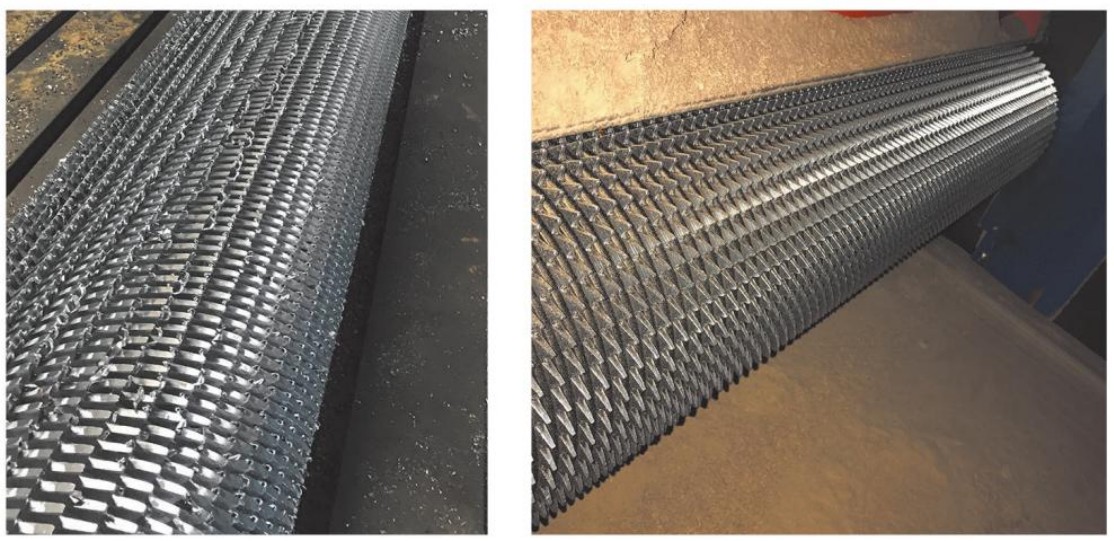
An Equalizing Roller is a rotating component installed within the forming section of a wood-based panel production line.
Its primary function is to interact with the loose particle mat and help create a more even material layer.
Depending on the forming machine design, the roller may help:
The exact working principle and installation position vary according to the machine configuration.
However, the basic objective remains the same:
Turn a naturally uneven loose material layer into a more controlled and uniform mat.
This distinction is especially important for understanding the product.
A Spreading Roller is mainly associated with distributing material across the forming width.
An Equalizing Roller focuses more on correcting or smoothing the material layer after particles have already entered the forming area.
The two functions can be viewed as:
Spreading = Distribute
Equalizing = Level
In a complete forming system, both functions may work together.
A simplified process can be understood as:
Material Feeding → Spreading → Equalizing → Mat Formation → Pre-Pressing
This is why the Equalizing Roller should not simply be considered another type of spreading roller.
A particle mat may look relatively uniform from a distance, but small differences can exist across its width and length.
These variations can come from:
If these differences remain uncorrected, the mat may enter the pre-pressing stage with a less consistent surface profile.
The Equalizing Roller is designed to help smooth out these local variations.
Much of the material preparation process takes place before the forming machine.
By the time particles reach the forming section, they have already been screened, dried, blended and metered.
But material preparation is not finished yet.
The loose particles still need to become a stable mat.
This means the final forming stage can be viewed as:
Prepared Material → Controlled Deposition → Surface Adjustment → Mat Formation
The Equalizing Roller operates within this final adjustment stage.
It helps create a more uniform material profile before the mat enters the next section.
This is one of the important reasons an Equalizing Roller is useful.
A production line may supply the correct total quantity of material, but the distribution can still be uneven.
For example:
Total material = correct
but
Local distribution = uneven
This distinction matters.
A weighing or metering system can control how much material enters the forming section.
However, it does not automatically guarantee that the material is perfectly level across the mat.
The Equalizing Roller addresses a different part of the problem:
Material quantity vs. Material distribution
The two functions complement each other.
The operating principle depends on the machine design, but the basic idea is relatively simple.
As the loose particle layer passes through the equalizing area, the rotating roller interacts with the upper surface of the material.
Higher areas receive controlled mechanical contact, while lower areas remain available for additional material distribution.
The result is a more balanced surface profile.
A simplified concept is:
Uneven Mat → Roller Contact → Local Correction → More Uniform Mat
The goal is not to compress the entire mat aggressively.
Instead, the roller provides a controlled leveling effect.
More mechanical action does not automatically mean better leveling.
The roller needs to correct surface variations without unnecessarily disturbing the structure of the particle mat.
Excessive interaction could potentially cause:
Therefore, the Equalizing Roller should be designed and adjusted according to the material characteristics and forming process.
The objective is:
Controlled correction, not aggressive compression.
The material entering the forming section is not always identical.
Important variables include:
Fine particles behave differently from larger particles.
Moisture can influence flowability and material interaction.
Changes in bulk density can affect the height and stability of the mat.
Irregular particles may behave differently from more uniform material.
Adhesive-coated particles can have different surface characteristics and flow behavior.
Because of these variables, Equalizing Roller performance should always be considered within the actual production environment.
The working surface determines how the roller interacts with the loose material.
A suitable surface should provide controlled contact without unnecessarily damaging or disturbing the particle layer.
Important considerations can include:
The right combination depends on the forming machine and production requirements.
The Equalizing Roller operates in an environment containing wood particles and fine dust.
Continuous contact can gradually wear the working surface.
As wear increases, the original roller geometry may change.
This can influence:
For this reason, the roller should be designed with suitable wear resistance for the actual production conditions.
For a component whose job is to level the mat, geometry matters.
Important technical parameters include:
Even relatively small dimensional changes can influence the working clearance between the roller and the material layer.
Therefore, Equalizing Rollers require both wear resistance and machining precision.
The Equalizing Roller is a rotating component.
If the roller is not correctly balanced or aligned, vibration may increase during operation.
Excessive vibration can affect:
For continuously operating production lines, smooth rotation is an important part of reliable roller performance.
Mat leveling and density distribution are closely related, but they are not exactly the same thing.
The Equalizing Roller does not independently determine the final board density profile.
However, a more consistent material layer can provide a more predictable starting condition for later pressing processes.
The overall chain is:
Material Metering → Particle Distribution → Mat Equalizing → Pre-Pressing → Hot Pressing
Each stage contributes to the final board structure.
This is why a stable equalizing process can support better downstream process consistency.
An uneven mat can create different working conditions across the forming width.
Depending on the production system, possible symptoms may include:
These symptoms may have many possible causes.
Material metering, spreading, machine settings and roller condition should all be considered when troubleshooting.
Selection should begin with the actual machine rather than the product name.
Important information includes:
Different forming systems can have different roller arrangements.
Must match the machine design.
Should correspond to the effective forming width.
Shaft diameter, length and mounting interfaces must be compatible.
The roller should be designed for the actual operating speed.
The required adjustment range should be taken into account.
Particle size, moisture, density and resin condition can all influence performance.
The working surface should match the intended leveling effect.
Different Particle Board production lines may use different machine configurations.
There may be differences in:
For this reason, customized production can be an effective option for replacement projects.
HUATAO can manufacture Equalizing Rollers according to:
This helps improve compatibility with the original forming equipment.
Regular inspection is important for maintaining stable leveling performance.
Recommended checks include:
Particular attention should be given to uneven wear.
If one area wears significantly faster than another, it may indicate differences in material loading, alignment or mechanical condition.
This is an important point when evaluating maintenance.
Mechanical failure is not the only reason to replace an Equalizing Roller.
A roller may continue rotating normally while its working geometry gradually changes.
At that stage, the issue is no longer:
“Does the roller rotate?”
The better question is:
“Does the roller still provide the intended leveling effect?”
This functional approach is particularly important for forming-section components.
The Equalizing Roller should always be evaluated together with other forming components.
A typical material path may include:
Metering System
↓
Spreading System
↓
Equalizing Roller
↓
Mat Forming
↓
Pre-Press Belt
↓
Pre-Press
↓
Continuous Press
Each component has its own role.
The Spreading Roller helps distribute.
The Equalizing Roller helps level.
The pre-press system consolidates.
The continuous press completes the board-forming process.
This division of functions is why the correct selection of each component matters.
HUATAO provides Equalizing Rollers / Mat Leveling Rollers and related forming-section components for wood-based panel production.
Applications can include:
For Equalizing Roller projects, HUATAO focuses on matching:
Roller Structure + Material Characteristics + Machine Geometry + Operating Conditions
Customized manufacturing can be arranged according to drawings, samples, machine models and technical specifications.
In a complete Particle Board production line, the Equalizing Roller is not one of the largest components.
But it performs a very specific function that cannot simply be replaced by a conventional conveyor roller.
Its role is to help transform a naturally variable particle layer into a more controlled material profile.
That makes it an important link between:
Particle Distribution and Mat Formation
Stable leveling can give the downstream pre-press system a more consistent starting condition.
The Equalizing Roller, also known as a Mat Leveling Roller or Smoothing Roller, is an important component in the forming section of wood-based panel production lines.
Its main task is not simply to convey material.
It helps correct local material differences, smooth the particle layer and maintain a more uniform mat profile before the material enters subsequent pressing stages.
Key performance considerations include:
Accurate geometry
Stable running
Wear resistance
Controlled surface interaction
Suitable working clearance
Reliable machine compatibility
For Particle Board, MDF, HDF, OSB and FOSB production lines, a properly designed Equalizing Roller can contribute to more consistent mat formation and a more stable downstream process.
The goal is simple:
Spread the material correctly, equalize the mat effectively, and create a better foundation for pressing.
HUATAO Wood-Based Panel Machinery
Email: bella@huataogroup.com
Tel: +86 17731169773
Website: www.woodpanelmachinery.com
HUATAO provides Equalizing Rollers, Spreading Rollers, Brush Rolls, forming-section components and machinery spare parts for Particle Board, MDF, HDF, OSB and FOSB production lines.
#EqualizingRollers #EqualizingRoller #MatLevelingRoller #ParticleBoardEqualizingRoller #ParticleBoardForming #ParticleMatForming #FormingSection #MatLeveling #MatSmoothing #ParticleDistribution #ParticleBoardFormingMachine #ParticleBoardMachinery #ParticleBoardSpareParts #WearResistantRoller #FormingMachineParts #ParticleBoardProductionLine #WoodBasedPanel #WoodBasedPanelMachinery #MatFormingEquipment #HUATAO
can not be empty
can not be empty

HUATAO Wood-based Panel Machinery Co., Ltd
ADD : No.298 Zhonghua North Street, Shijiazhuang 050000 China.
TEL : +86 0311 80690567
EMAIL :bella@huataogroup.com
Web: www.woodpanelmachinery.com
 WhatsApp & WeChat : +86 17731169773