
In wood-based panel production, storage bins and hoppers are essential for buffering and supplying raw materials between different process sections. However, storing material is only part of the job.
The real challenge comes when the material needs to be discharged continuously, evenly and reliably.
For materials such as wood chips, particles, fibers and strands, gravity alone may not always provide stable discharge. Poor-flowing or compacted bulk materials can create bridging, stagnant zones or uneven feeding, which may then affect downstream equipment.
This is where the Rotary Discharging Mechanism, commonly known in the industry as an Extractor, becomes an important part of the material handling system.
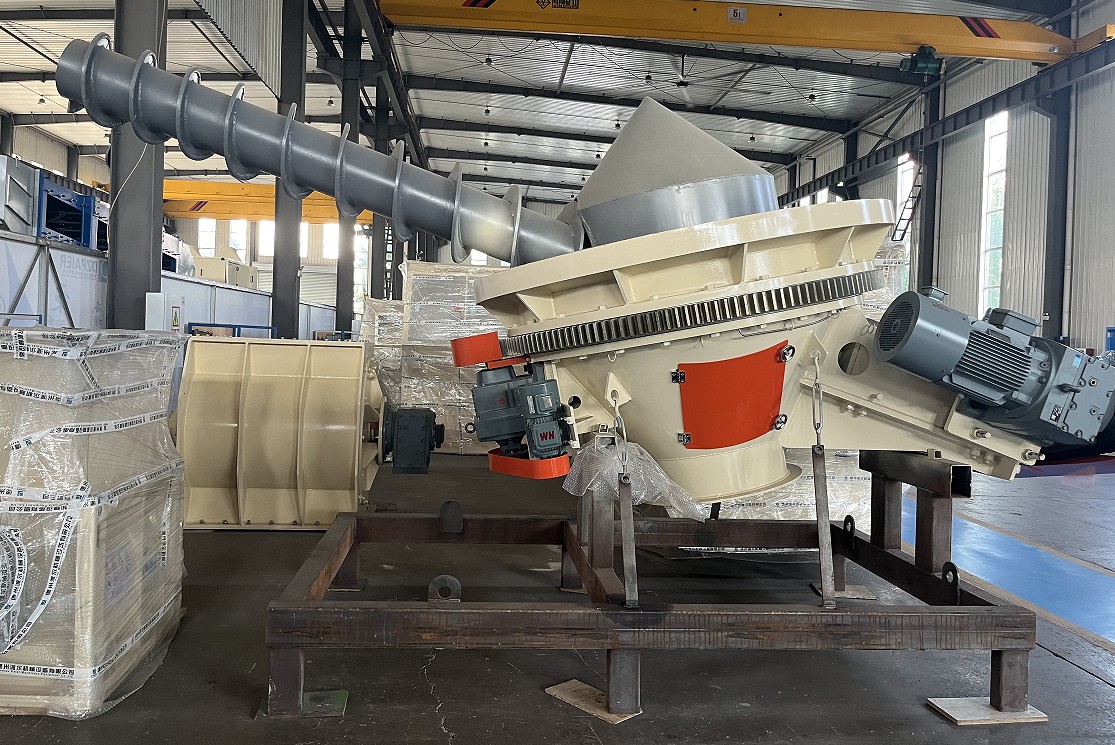
A Rotary Discharging Mechanism is a mechanical extraction device installed at or beneath a storage bin, hopper or similar bulk-material container.
Its primary function is to actively extract material from the bottom of the storage unit and deliver it to downstream conveying or processing equipment.
Instead of relying entirely on natural gravity flow, the rotating mechanism helps move stored material toward the discharge outlet.
Depending on the machine and material characteristics, different extractor designs may be used, including various rotating, screw, chain, arm or other mechanical extraction arrangements. Equipment suppliers in the wood-processing sector commonly classify extractors by their working principle and application.
Wood-based panel production involves large quantities of bulk materials.
Depending on the process, these materials may include:
These materials do not always flow freely.
Changes in moisture content, particle geometry, bulk density and compaction can influence how material behaves inside the storage bin.
Without a suitable extraction system, several problems can occur:
Material may form a bridge above the outlet and stop flowing naturally.
Only material near the center of the outlet may move, while material remains inactive around the bin walls.
The flow rate may fluctuate instead of remaining consistent.
Long-term storage and pressure from the material column can increase compaction.
If material fails to discharge correctly, the downstream conveyor or processing machine may be starved.
These are exactly the types of bulk-material discharge problems that mechanical extractors are designed to address. Rotary discharge systems are commonly used when gravity discharge alone is insufficient, particularly for poorly flowing materials.
Although the mechanical design can vary according to the application, the basic operating principle is straightforward.
Material is stored inside the bin or hopper.
When the extractor starts operating, its rotating components move through the lower material layer and direct the material toward the discharge area.
The extracted material then enters downstream equipment such as:
The result is a more controlled material flow between the storage stage and the next processing stage.
Gravity discharge is simple and effective for materials that flow freely.
However, wood-based panel raw materials can behave differently.
A storage bin may contain a large amount of lightweight, fibrous or irregularly shaped material. Under pressure, the material can compact or form zones with different flow characteristics.
In such applications, an active extraction mechanism provides a significant advantage.
Rather than waiting for the material to flow naturally, the extractor actively moves material toward the outlet.
This can help improve:
In MDF and HDF production, wood fibers are often stored temporarily in bins before entering subsequent processing equipment.
Because fibers are lightweight and can be affected by moisture, static electricity and compaction, stable extraction from the storage bin is important.
A properly selected extractor can help maintain consistent discharge from the bin and reduce material accumulation.
This is particularly important when the storage bin feeds a metering system.
The general process can be represented as:
Fiber Storage → Rotary Extractor → Metering Belt → Weighing / Dosing → Downstream Process
Stable extraction provides a better foundation for accurate material metering.
Particle Board production uses wood particles with different sizes and fractions.
After screening, drying or blending, materials may be temporarily stored before they are delivered to the next production stage.
If the discharge is unstable, the downstream system may experience fluctuations in material supply.
A Rotary Discharging Mechanism can help regulate the release of material from the bottom of the bin and maintain a more consistent flow.
This is especially valuable when the extractor is integrated with a Metering Bin and Particle Belt Scale.
In this configuration:
Extractor → Metering Belt → Weighing → Flow Control
the extractor handles material extraction while the downstream weighing system monitors the actual material flow.
OSB and FOSB production relies heavily on wood strands.
Compared with fine fibers, strands have significantly different geometry and flow behavior.
Their length, shape and orientation can influence how they move and accumulate inside storage bins.
A suitable extraction system therefore needs to be selected according to the physical characteristics of the stored material.
The objective is not simply to remove material from the bin.
It is to provide:
Stable extraction + Controlled discharge + Continuous downstream supply
This contributes to a more predictable material flow before the forming section.
A properly designed Extractor can provide several functions within a wood-material handling system.
The rotating mechanism actively removes material from the bottom of the bin.
Continuous mechanical movement can help reduce sudden changes in material flow.
Active extraction can help prevent material from remaining suspended above the outlet.
The extraction system can help reduce inactive material zones within the storage area.
A more consistent discharge provides better material supply to conveyors, dosing systems and processing equipment.
The extractor can be incorporated into the broader material handling and process control system.
These two components are sometimes confused because they can be installed close to each other.
However, their responsibilities are different.
The primary task is:
Extract material from the storage bin.
The primary task is:
Transport material and control or measure the feeding rate.
In a complete system, the two can work together:
Storage Bin
↓
Rotary Extractor
↓
Metering Belt
↓
Particle Belt Scale
↓
Next Process
The extractor ensures that material leaves the bin reliably, while the metering and weighing system provides more precise control of material flow.
The extractor is located at a critical point in the material flow path.
A mechanical problem here can affect the entire downstream process.
Typical issues may include:
When these problems occur, the production line may experience unstable feeding or even unplanned downtime.
Therefore, extractor design and component quality deserve the same attention as other major conveying components.
The exact configuration varies by equipment design, but a typical system may include:
Provides rotational power to the extraction mechanism.
Reduces speed and increases torque according to application requirements.
The main working mechanism that moves the stored material toward the discharge outlet.
Provides mechanical support and maintains alignment.
Connects the extractor with the next conveying or processing stage.
Allows the extractor to operate according to production requirements.
For heavy-duty industrial applications, the mechanical structure must be designed for continuous operation and appropriate material loads.
Not every extractor is suitable for every material.
Before selecting an Extractor, it is important to consider:
Material Type
Wood fiber, particles, chips and strands have different physical characteristics.
Moisture Content
Higher moisture can affect flowability and material adhesion.
Bulk Density
Differences in bulk density influence the required extraction capacity.
Particle Size
Fine particles behave differently from larger chips or strands.
Storage Capacity
The size and geometry of the bin affect the required extraction design.
Required Throughput
The extractor must match the actual production flow rate.
Operating Conditions
Continuous operation requires appropriate mechanical strength and wear resistance.
Rotary Discharging Mechanisms and Extractors can be used in various bulk-material handling applications, including:
The wood-processing industry includes several types of extractor solutions, such as vertical, worm, chain, arm and moving-floor extraction systems, depending on storage design and material characteristics.
Regular maintenance is essential for reliable operation.
Important inspection points include:
For continuous production lines, preventive maintenance can help detect mechanical problems before they cause major production interruptions.
In a large wood-based panel plant, the storage bin may contain a significant quantity of production material.
However, storage capacity alone does not guarantee reliable material supply.
The material must be discharged in a controlled way.
This means the Extractor becomes a critical link between:
Material Storage → Material Extraction → Metering → Conveying → Processing
A failure at the extraction stage can quickly influence everything downstream.
Therefore, a well-designed Rotary Discharging Mechanism should provide the combination of:
Mechanical strength + Stable rotation + Wear resistance + Reliable discharge + Easy maintenance
HUATAO focuses on machinery spare parts, conveying equipment and material handling solutions for wood-based panel production.
Our solutions can support applications involving:
For extractor applications, the selection process should consider the bin structure, material characteristics, required capacity and downstream equipment.
Instead of treating the extractor as an isolated mechanical component, HUATAO focuses on its role within the complete material handling system.
A modern wood-based panel production line depends on coordinated material handling.
The complete process can be viewed as:
Storage → Extraction → Metering → Weighing → Conveying → Processing
The Rotary Discharging Mechanism provides the first active step after material storage.
When the extractor operates reliably, the downstream metering and conveying systems have a more stable material supply.
This is why a component that is often hidden underneath the bin can have a significant influence on the overall performance of the production line.
The Rotary Discharging Mechanism, also known as an Extractor, is an important mechanical solution for controlled discharge of bulk materials from storage bins and hoppers.
For MDF, Particle Board, OSB, FOSB and other wood-processing applications, it can help address common material-flow problems such as bridging, compaction, inactive zones and unstable discharge.
When properly matched with the storage bin, material characteristics and downstream metering equipment, an Extractor can contribute to:
More stable discharge
More reliable material feeding
Better process continuity
Reduced material accumulation
Improved production efficiency
At HUATAO, we understand that reliable material handling begins at the bottom of the storage bin.
HUATAO Wood-Based Panel Machinery
Email: bella@huataogroup.com
Tel: +86 17731169773
Website: www.woodpanelmachinery.com
HUATAO provides wood-based panel machinery spare parts, industrial conveyor belts, material handling equipment and process solutions for MDF, HDF, Particle Board, OSB and FOSB production lines.
#RotaryDischargingMechanism #Extractors #RotaryExtractor #BinBottomExtractor #HopperExtractor #MaterialExtractor #RotaryDischarge #BinDischargingSystem #DosingBin #StorageBin #WoodChipExtractor #WoodFiberExtractor #ParticleExtractor #MDF #ParticleBoard #OSB #FOSB #WoodBasedPanel #WoodBasedPanelMachinery #HUATAO
can not be empty
can not be empty

HUATAO Wood-based Panel Machinery Co., Ltd
ADD : No.298 Zhonghua North Street, Shijiazhuang 050000 China.
TEL : +86 0311 80690567
EMAIL :bella@huataogroup.com
Web: www.woodpanelmachinery.com
 WhatsApp & WeChat : +86 17731169773