
In a wood-based panel production line, the forming section is where loose particles are transformed into a continuously distributed material mat.
This process depends on much more than the main forming machine.
Material feeding, spreading, leveling and surface condition all influence how steadily the line operates.
One component that is easy to overlook is the Brush Roll.
Also known as a Cleaning Brush Roll, it is used in the forming section to help remove residual particles, dust and accumulated material from designated machine surfaces.
Although it is a relatively simple mechanical component, its function is closely connected with one important production principle:
A cleaner forming environment helps maintain more consistent material handling.
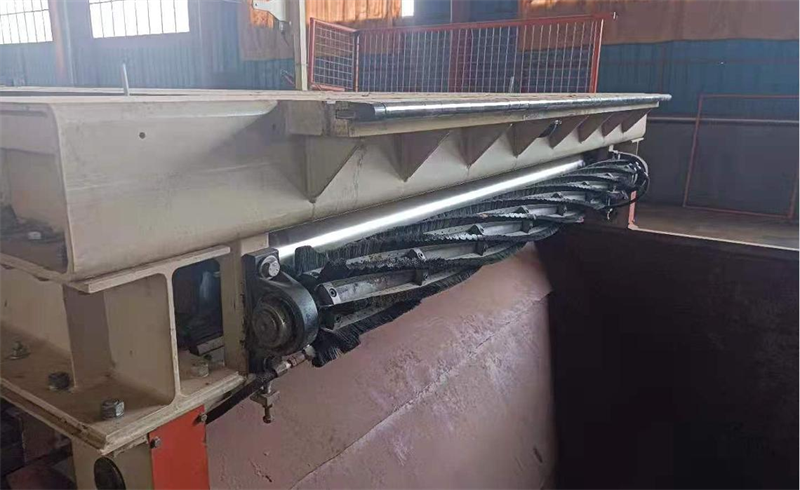
The forming section continuously handles wood particles, fibers and other fine materials.
During production, some particles may not remain exactly where they are intended to be.
They can accumulate on:
Over time, this buildup can influence material movement.
Instead of being a clean, repeatable process, the equipment begins operating with additional material attached to surfaces that were not designed to carry it.
That is where cleaning becomes part of process control.
It is easy to think of a brush as a simple cleaning tool.
In the forming section, however, its role can be more important.
The brush may help:
The objective is not simply to make the machine look cleaner.
The real purpose is to help keep the equipment in a more predictable working condition.
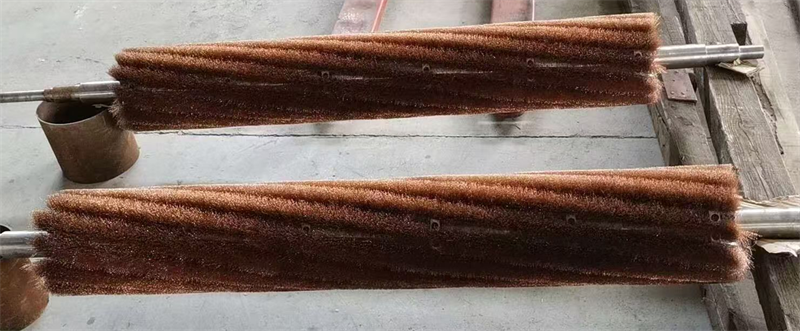
A small amount of accumulated material may not appear significant at first.
But continuous production changes the situation.
A small deposit can become a larger buildup.
That buildup can then affect:
Surface condition → Material contact → Cleaning efficiency → Material flow
Possible consequences may include:
In other words, the cost of poor cleaning may not appear as a single obvious failure.
It can show up as a gradual loss of process stability.
Particle Board production typically includes several interconnected stages:
Particle Preparation → Screening → Drying → Glue Blending → Metering → Forming → Pre-Press → Hot Press
The Brush Roll belongs to the forming environment, where large quantities of prepared particles are continuously distributed and handled.
At this stage, maintaining clean working surfaces can help prevent residual material from interfering with the forming process.
The Brush Roll therefore works as part of the broader material-management and equipment-cleaning system.
The forming section is exposed to several challenging conditions.
A high production rate naturally means more particles pass through the machine every hour.
Smaller particles can settle on surfaces and accumulate over time.
Depending on the production process, particles may carry adhesive or other residues.
Even a small accumulation can grow significantly over long operating cycles.
Stopping the line frequently for manual cleaning is inefficient.
This is why an automatically rotating cleaning component can provide an important operational advantage.
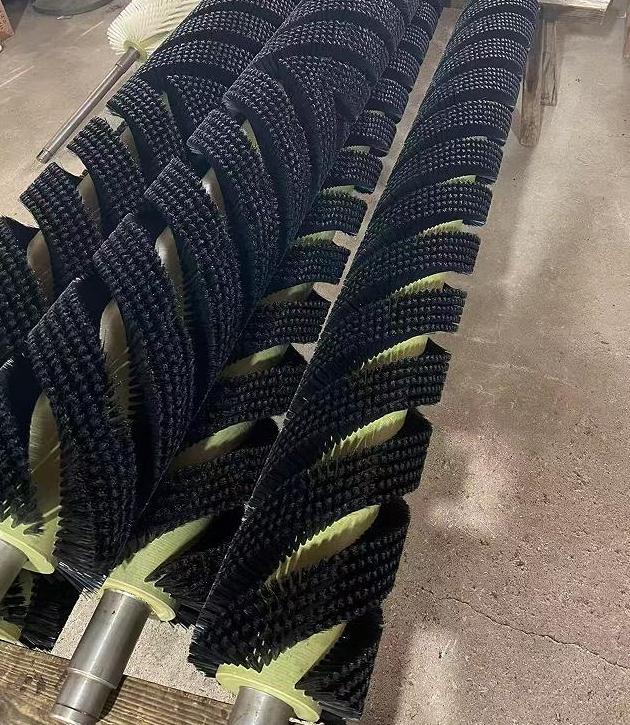
Manual cleaning still has its place during maintenance.
However, relying entirely on manual cleaning is difficult for a continuously operating production line.
A Brush Roll provides a more proactive approach:
Continuous Rotation → Continuous Surface Contact → Ongoing Material Removal
This can reduce the amount of residual material allowed to accumulate between maintenance cycles.
The objective is not to eliminate all manual cleaning.
Instead, it is to reduce unnecessary buildup before it becomes a larger problem.
Not every brush is suitable for an industrial forming application.
The brush needs to work against wood particles, dust and potentially adhesive residues without damaging the machine surface it is intended to clean.
Important characteristics may include:
A brush that is too soft may not remove buildup effectively.
A brush that is too aggressive may create unnecessary wear.
The correct solution depends on the actual application.
The brush element itself is only part of the product.
Overall performance can also depend on:
A properly selected Brush Roll should work in coordination with the machine rather than simply contacting the surface as aggressively as possible.
One of the most useful ways to understand the Brush Roll is as a material accumulation control device.
Its purpose is to influence what happens to residual particles before they become a larger buildup.
The process can be viewed as:
Residual Material → Brush Contact → Removal / Redistribution → Cleaner Working Surface
This is particularly useful where production materials are continuously entering the same forming area.
The distance between the Brush Roll and the surface being cleaned has a direct relationship with cleaning performance.
If the brush is too far away, contact may be insufficient.
If the brush is installed too tightly, it may create excessive resistance and accelerate brush wear.
Correct clearance should therefore be determined according to:
Proper adjustment helps balance cleaning effectiveness and component life.
The brush is itself a wear component.
After long-term operation, the bristles may become:
As the brush profile changes, cleaning effectiveness may gradually decrease.
Therefore, Brush Roll maintenance should include monitoring the actual condition of the brush rather than waiting until material buildup becomes obvious.
Operators can monitor:
More residual particles remain on the surface after the normal cleaning cycle.
The same operating conditions no longer produce the previous cleaning result.
Only part of the brush width shows significant deterioration.
May indicate balance or mounting problems.
Could be related to bearings, shaft alignment or excessive brush contact.
Broken, bent or flattened bristles may indicate incorrect operating conditions.
Different materials may create different cleaning requirements.
Fine fibers and dust may require a different brush structure from larger particles.
Particle size and resin characteristics can influence brush contamination.
Larger strands create different mechanical contact conditions.
Therefore, a Brush Roll should be selected based on:
Material + Machine + Contact Surface + Operating Conditions
rather than simply by diameter.
A cleaning component may appear unrelated to production efficiency.
But consider the chain:
More Residue → More Buildup → More Manual Cleaning → More Adjustments → More Downtime
The reverse is also true:
Effective Cleaning → Cleaner Working Area → More Predictable Material Handling → Fewer Unnecessary Interventions
The Brush Roll does not increase production capacity directly.
Its value comes from helping the forming section remain in a more stable operating condition.
For replacement projects, the following information should be confirmed:
Different forming machines may use different brush-roll arrangements.
Including brush diameter, length and shaft dimensions.
Fiber material, stiffness and density.
Must match the effective cleaning area.
Important for both cleaning efficiency and service life.
Bearings, shafts and supporting structures must be compatible.
The exact installation position helps determine the appropriate brush construction.
Industrial forming equipment often varies from one production line to another.
A standard Brush Roll may not always provide the correct fit or cleaning behavior.
HUATAO can supply customized Brush Rolls according to:
This allows the replacement component to be matched more closely with the original machine.
To maintain stable cleaning performance, operators should regularly check:
Cleaning the Brush Roll itself may also be necessary if resin-coated particles or dust become attached to the brush structure.
A Brush Roll may be one of the smallest components in a forming section.
But its role is very practical.
The forming system works best when material goes where it is supposed to go and unwanted accumulation is kept under control.
The Brush Roll contributes to that condition by continuously removing residual material from designated surfaces.
It is not the main forming machine.
It does not replace a metering system.
It does not determine the final board quality by itself.
Its role is simpler:
Keep the working area cleaner so the main process can operate more consistently.
HUATAO provides Brush Rolls / Cleaning Brush Rolls for wood-based panel production lines and industrial material-handling systems.
Applications can include:
For Brush Roll projects, HUATAO focuses on the relationship between:
Brush Design + Material Characteristics + Machine Structure + Cleaning Position + Operating Conditions
Customized production can be arranged according to drawings, samples and equipment specifications.
Brush Rolls are simple-looking but useful components in wood-based panel forming systems.
Their main role is to help remove residual particles, fibers and buildup from designated machine surfaces, supporting a cleaner and more stable operating environment.
Their value can be summarized as:
Continuous Cleaning
Reduced Material Buildup
Improved Surface Condition
Lower Manual Cleaning Pressure
More Predictable Material Handling
Better Maintenance Control
The right Brush Roll should not simply fit the machine.
It should also provide the appropriate brush material, density, stiffness, dimensions and operating characteristics for the actual production environment.
For MDF, HDF, Particle Board, OSB and FOSB production lines, a well-matched Cleaning Brush Roll can be a small component with a practical contribution to forming-section reliability.
HUATAO Wood-Based Panel Machinery
Email: bella@huataogroup.com
Tel: +86 17731169773
Website: www.woodpanelmachinery.com
HUATAO provides Brush Rolls, Cleaning Brush Rolls, Spreading Rollers, forming-section components and machinery spare parts for MDF, HDF, Particle Board, OSB and FOSB production lines.
#BrushRolls #CleaningBrushRolls #BrushRoll #CleaningBrushRoller #FormingSection #ParticleBoardForming #ParticleBoard #ParticleBoardMachinery #MDFForming #HDFProduction #OSBProduction #FOSB #MatForming #ParticleSpreading #FormingMachineParts #WoodBasedPanel #WoodBasedPanelMachinery #IndustrialBrushRoll #ParticleBoardProductionLine #HUATAO
can not be empty
can not be empty

HUATAO Wood-based Panel Machinery Co., Ltd
ADD : No.298 Zhonghua North Street, Shijiazhuang 050000 China.
TEL : +86 0311 80690567
EMAIL :bella@huataogroup.com
Web: www.woodpanelmachinery.com
 WhatsApp & WeChat : +86 17731169773