
In Particle Board production, the quality of the final board begins long before the material reaches the hot press.
Wood particles must first be prepared, classified, dried, blended with resin and then distributed into a continuous mat with the required thickness and material profile.
This makes the forming section one of the most important stages in the production process.
Among the various mechanical components used in this section, the Spreading Roller plays an important role in controlling how loose particles are distributed and handled during mat formation.
Although it is smaller than the major forming equipment, its working condition can influence the consistency of the material layer and the overall stability of the forming process.
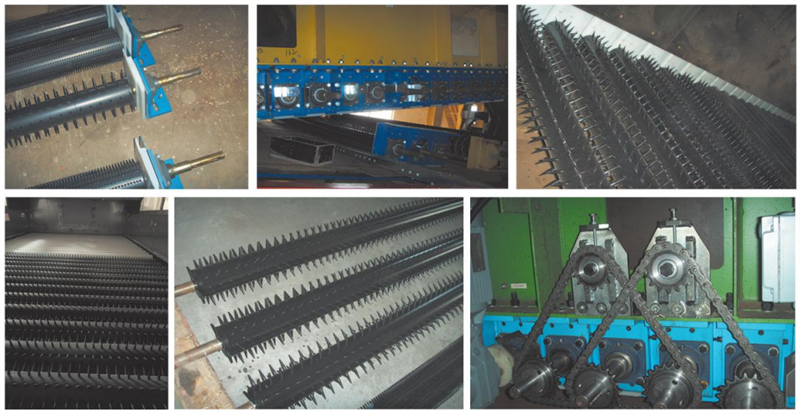
A Spreading Roller is a mechanical roller used in the forming section of wood-based panel production lines to assist with the distribution, leveling or controlled movement of loose wood particles.
Depending on the forming machine configuration, the roller interacts with the material layer and helps influence the way particles are spread across the working width.
Its exact function may vary according to machine design, but the main objective is generally related to creating a more uniform and controllable particle layer.
For Particle Board production, this is important because the initial distribution of particles affects the structure of the mat before pre-pressing and hot pressing.
A Particle Board mat is not simply a pile of loose particles.
Its thickness, density distribution and material concentration need to remain within the required production range.
If material is distributed unevenly, several issues may develop:
A stable spreading process helps the forming section create a more consistent material layer before the next production stage.
The basic relationship can be expressed as:
Material Feeding → Particle Spreading → Mat Formation → Pre-Pressing → Hot Pressing
The Spreading Roller belongs to the critical transition between material feeding and final mat formation.
A standard conveyor roller mainly supports or transports material.
A Spreading Roller has a different purpose.
Its operation is connected with how loose particles behave across the forming width.
Depending on the machine design, the roller may contribute to:
This means its performance needs to be considered from the perspective of the forming process, not only from the perspective of mechanical rotation.
The exact operating principle depends on the forming machine.
In general, the prepared material enters the forming area and is distributed across the required width.
The Spreading Roller then works within this material-flow path, helping redistribute or level particles according to the machine's design.
The process can be simplified as:
Incoming Particles → Material Distribution → Spreading Action → Mat Leveling → Formed Mat
The goal is not necessarily to move the maximum amount of material.
The more important objective is to achieve a stable and repeatable material distribution pattern.
One common misunderstanding is to evaluate a spreading component mainly by how much material it can handle.
For forming applications, throughput is only part of the requirement.
The more important question may be:
How evenly can the material be distributed under continuous production conditions?
A high-capacity spreading system that creates uneven material concentration may not provide the desired process performance.
For this reason, Spreading Roller design should take into account:
The forming mat becomes the basis for the later pressing process.
If the particle layer has significant variation before pressing, the downstream process may have to compensate for these differences.
A more controlled material distribution can support:
The Spreading Roller cannot determine final board quality by itself, but it can be an important part of maintaining stable forming conditions.
Particle Board production does not always use identical raw materials.
Particle characteristics may vary in:
These differences can affect how the material moves through the forming system.
A roller designed for one application may not necessarily provide the same result in another.
Therefore, Spreading Roller selection should be connected with the actual material characteristics and machine configuration.
The working surface of the Spreading Roller can directly influence its interaction with the material.
Depending on the machine design, different surface structures or configurations may be used.
The surface needs to provide sufficient mechanical interaction while avoiding unnecessary disturbance to the particle layer.
Important considerations may include:
A suitable surface should provide controlled material interaction rather than simply aggressive mechanical action.
Wood particles are abrasive materials.
The Spreading Roller may operate continuously while exposed to particles and fine dust.
Over time, wear can alter the roller's original surface condition and geometry.
This may affect the way the component interacts with the material.
Potential consequences include:
For continuously operating Particle Board plants, wear resistance is therefore an important part of roller design.
A Spreading Roller needs to maintain its designed geometry during operation.
Important parameters include:
If these parameters change significantly because of wear or mechanical damage, the operating condition of the forming system can also change.
This is why a high-quality Spreading Roller requires not only suitable material but also accurate manufacturing.
The Spreading Roller is a rotating component.
At operating speed, poor balance or incorrect alignment can create unnecessary vibration.
Excessive vibration may affect:
A properly manufactured and balanced roller can support smoother operation and reduce unnecessary mechanical stress.
For high-speed or continuous applications, dynamic performance deserves attention during product selection.
The functional difference can be summarized as follows:
| Conventional Conveyor Roller | Spreading Roller |
|---|---|
| Primarily supports conveying | Designed to influence material distribution |
| Focus on transportation | Focus on spreading and leveling |
| Passive material contact | Controlled interaction with material |
| General conveying applications | Forming-section applications |
| Basic roller performance | Material + mechanical process performance |
The Spreading Roller should therefore be regarded as a forming-process component, not simply another conveyor roller.
A forming system may show several warning signs when the spreading roller is not operating correctly.
These may include:
The particle layer may show differences across the machine width.
Some areas may receive excessive material.
The formed mat may become less uniform.
Mechanical imbalance or wear may influence running stability.
Operators may need to make repeated corrections to maintain production conditions.
When these symptoms occur, the complete forming system should be inspected rather than automatically blaming the roller alone.
A suitable Spreading Roller should be selected according to the actual production environment.
Important information includes:
Different forming systems can use different roller arrangements.
Diameter, width and shaft configuration need to match the equipment.
The roller should be suitable for the actual operating speed.
Higher throughput can create greater mechanical and material-handling demands.
Particle size, moisture, density and flow behavior should be considered.
The working surface needs to match the required spreading effect.
Bearings, shafts, couplings and supporting components must be compatible.
Not all Particle Board production lines use exactly the same forming configuration.
Differences may exist in:
For replacement projects, customized manufacturing can therefore provide better compatibility than a generic standard component.
HUATAO can evaluate Spreading Roller specifications based on:
Regular maintenance can help maintain stable forming performance.
Recommended inspection includes:
Early detection of abnormal wear or mechanical changes can help prevent larger problems within the forming system.
A Particle Board forming section is a connected system rather than a collection of isolated components.
Material metering controls how much material enters the system.
The forming equipment determines how that material is distributed.
The Spreading Roller helps influence the material layer.
The pre-press then consolidates the mat before hot pressing.
This can be represented as:
Metering → Distribution → Spreading → Mat Formation → Pre-Pressing → Hot Pressing
Stable operation at each stage supports the next stage.
This is why the Spreading Roller should be selected and maintained as part of the overall forming process.
HUATAO provides forming-section components and machinery spare parts for wood-based panel production lines.
Our application range includes:
For Spreading Roller applications, HUATAO focuses on matching:
Roller Design + Material Characteristics + Machine Configuration + Operating Conditions
Customized production can be arranged according to customer drawings, samples, machine models and technical requirements.
The forming section determines how loose material becomes a controlled mat.
The Spreading Roller is one of the components operating directly within this transition.
Its importance is not simply related to rotation speed or mechanical strength.
The real value lies in its ability to maintain stable, repeatable interaction with the particle layer throughout continuous operation.
A well-designed roller can support more consistent spreading performance, while a worn or poorly matched roller may gradually introduce instability into the process.
The Spreading Roller is an important mechanical component in Particle Board forming systems.
Its role is closely connected with particle redistribution, material leveling and mat consistency.
The main performance considerations include:
Stable material interaction
High wear resistance
Dimensional accuracy
Reliable running stability
Suitable surface design
Machine compatibility
Long-term operating performance
For Particle Board manufacturers, choosing the right Spreading Roller is not simply a matter of selecting a roller by size.
It requires a combination of material understanding, mechanical precision and application-specific design.
When the roller is correctly matched to the forming machine and production conditions, it can provide a more stable foundation for continuous mat formation and downstream pressing.
HUATAO Wood-Based Panel Machinery
Email: bella@huataogroup.com
Tel: +86 17731169773
Website: www.woodpanelmachinery.com
HUATAO provides Spreading Rollers, forming-section components, machinery spare parts and material-handling solutions for Particle Board, MDF, HDF, OSB and FOSB production lines.
#SpreadingRoller #ParticleBoardSpreadingRoller #MatSpreadingRoller #SpreadingRollerForParticleBoard #ParticleBoardForming #FormingSection #ParticleMat #ParticleDistribution #MatFormingRoller #ParticleBoardFormingMachine #ParticleBoardMachinery #ParticleBoardSpareParts #WearResistantRoller #MatFormingEquipment #ParticleBoardProductionLine #WoodBasedPanel #WoodBasedPanelMachinery #MaterialSpreading #FormingMachineParts #HUATAO
can not be empty
can not be empty

HUATAO Wood-based Panel Machinery Co., Ltd
ADD : No.298 Zhonghua North Street, Shijiazhuang 050000 China.
TEL : +86 0311 80690567
EMAIL :bella@huataogroup.com
Web: www.woodpanelmachinery.com
 WhatsApp & WeChat : +86 17731169773