
In MDF and HDF manufacturing, producing high-quality boards starts long before the forming and pressing stages.
After refining and thermal-mechanical processing, wood fibers must be delivered to the downstream process in a condition that allows them to flow, distribute and form a stable mat.
However, fibers can become compacted, tangled or unevenly distributed during transportation and processing.
This is where Disintegrating Rolls, also known as Loosening Rolls or Disintegrator Rolls, play an important role.
By mechanically loosening and separating compacted fibers, these rolls help improve material flow and prepare the fiber stream for subsequent processing.
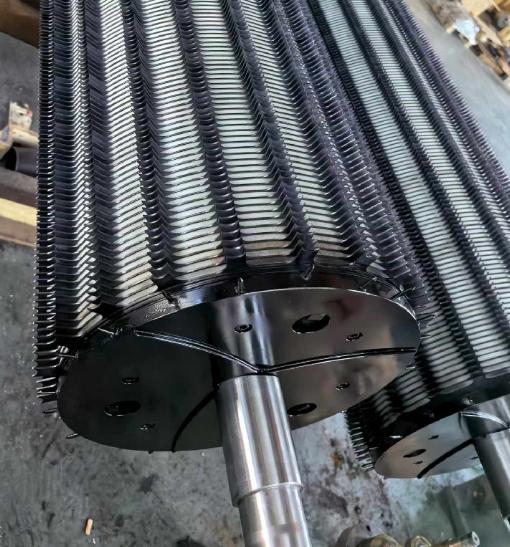
Disintegrating Rolls are rotating mechanical components designed to break up compacted fiber material, loosen fiber agglomerates and promote more uniform material flow.
They are commonly used in wood fiber handling and preparation sections where the material needs to be separated before entering the next process.
Unlike a conventional conveying roller, a Disintegrating Roll is designed to interact actively with the material.
Its purpose is not simply to support or transport the fiber.
It helps to:
This makes Disintegrating Rolls particularly relevant to continuous MDF and HDF production.
Wood fibers are lightweight and irregular in shape.
After refining, drying or conveying, they may not remain evenly separated.
Under certain operating conditions, fibers can form:
Small groups of fibers may stick together and form agglomerations.
Pressure and transportation can cause fibers to become compressed.
The fiber stream may contain areas with different material concentrations.
Compacted fibers may not move smoothly through downstream equipment.
These conditions can affect subsequent processes.
For example, irregular fiber distribution may make it more difficult to achieve a stable material flow before forming.
Therefore, fiber loosening is an important part of maintaining consistent material preparation.
The basic operating principle is based on controlled mechanical rotation.
As the fibers pass through the working area, the rotating roll interacts with the material and helps separate compacted fiber masses.
Depending on the machine design, the working roll may use specific surface structures, teeth, bars, pins or other mechanical features to improve fiber dispersion.
The exact geometry depends on the application and material characteristics.
The general material flow can be understood as:
Compacted Fibers → Mechanical Loosening → Fiber Separation → Improved Flow → Downstream Processing
The objective is not to excessively damage the fibers.
Instead, the goal is to create a more uniform and manageable fiber stream.
MDF production depends heavily on properly prepared wood fibers.
After the fiberizing process, the material may pass through several conveying, drying and storage stages before reaching forming equipment.
During these stages, fiber agglomeration can occur.
Disintegrating Rolls can be used to improve the condition of the fiber stream before further processing.
Potential benefits include:
A stable fiber stream can provide a better foundation for mat forming and subsequent pressing.
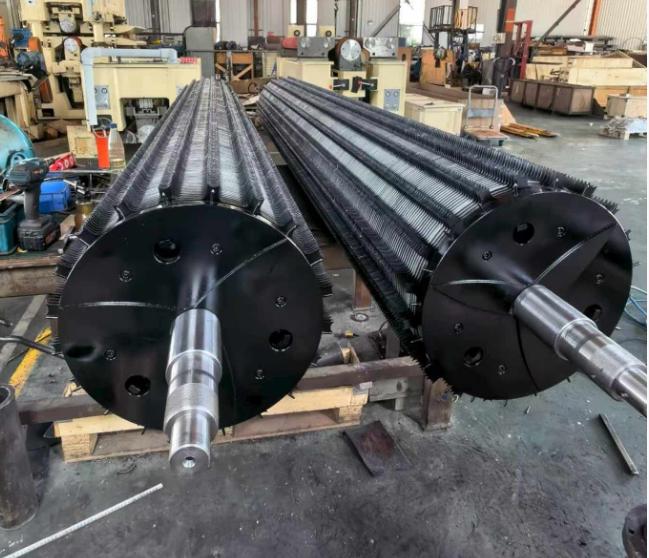
HDF production generally requires careful control of fiber preparation and distribution.
Because the board density is higher than conventional MDF, consistency in the forming process becomes especially important.
Disintegrating Rolls can help maintain a more homogeneous fiber flow by reducing the presence of compacted fiber masses.
When properly integrated into the process, the equipment can support more stable feeding to downstream systems.
The complete process may be arranged as:
Fiber Preparation → Drying → Storage → Loosening / Disintegration → Metering → Forming
The exact configuration depends on the production line design.
Fiber loosening should not be viewed as an isolated process.
The condition of the fibers entering the next section can influence how material behaves downstream.
When fibers are excessively compacted, they may not distribute uniformly.
This can potentially lead to:
By improving fiber separation, Disintegrating Rolls can help create a more consistent material stream.
This is especially useful before metering or forming equipment.
A standard conveying roller primarily supports or transports material.
A Disintegrating Roll has a different purpose.
| Conventional Roller | Disintegrating Roll |
|---|---|
| Supports material | Actively interacts with material |
| Mainly assists conveying | Helps loosen and separate material |
| Passive material contact | Controlled mechanical action |
| Focus on transportation | Focus on material conditioning |
| General conveying applications | Fiber and bulk-material processing |
The working principle is therefore significantly different.
Disintegrating Rolls should be considered a material-conditioning component, rather than simply a conveyor roller.
A properly designed Disintegrating Roll can perform several important functions.
Helps release compressed fibers and improve material openness.
Reduces larger clumps of material before downstream processing.
Helps the fiber stream move more consistently.
Supports a more even distribution of fibers across the processing width.
Helps minimize localized material buildup.
Provides better material conditions for downstream metering and forming.
The working surface is one of the most important features of a Disintegrating Roll.
Different applications may require different surface structures.
Factors may include:
An excessively aggressive surface may damage material unnecessarily, while insufficient mechanical action may not effectively break up agglomerates.
Therefore, surface design should be matched to the application.
When selecting Disintegrating Rolls, several parameters should be considered.
Determines the mechanical geometry and operating characteristics of the roll.
Should correspond to the effective material-processing width.
The speed influences the intensity of material interaction.
Teeth, bars, pins or other configurations can be selected according to the material.
The clearance between the roll and surrounding equipment affects the degree of material treatment.
The roll should match the required production capacity.
Moisture, particle size and degree of compaction can all influence selection.
If fiber agglomerates are not adequately separated, problems may appear downstream.
Typical symptoms may include:
In some cases, operators may initially suspect problems with the conveyor, metering system or forming equipment.
However, the actual issue may begin earlier in the material preparation process.
That is why fiber condition should be evaluated together with the performance of the downstream equipment.
An important application is the combination of Disintegrating Rolls with Metering Belts or Weighing Systems.
A metering system works most effectively when the material entering the belt is reasonably stable and uniformly distributed.
If the incoming fiber contains large agglomerates, the load on the belt may fluctuate.
This can make material metering more difficult.
The general arrangement can therefore be:
Fiber Storage → Disintegrating Rolls → Metering Bin → Metering Belt → Weighing → Forming
The Disintegrating Roll improves the physical condition of the material, while the metering system controls the quantity being supplied.
The two functions are complementary.
Disintegrating Rolls may be used in applications involving:
The specific design should always be matched to the production process and material characteristics.
Because Disintegrating Rolls operate under continuous contact with abrasive wood materials, regular inspection is important.
Recommended maintenance points include:
Inspect working teeth, bars, pins or other contact surfaces.
Monitor bearing temperature, noise and vibration.
Look for abnormal wear or alignment problems.
Check the motor, gearbox, coupling and transmission system.
Clean deposits that may affect roll rotation or material flow.
Ensure that the operating gap remains within the required range.
Unexpected vibration can indicate mechanical imbalance, wear or alignment problems.
Preventive maintenance can reduce the risk of unexpected downtime.
Disintegrating Rolls work in a highly abrasive environment.
Wood fibers, particles and other raw materials can continuously contact the working surface.
Over time, this can cause:
For this reason, material selection and surface treatment should be considered carefully.
The most suitable solution depends on operating conditions, material characteristics and expected service life.
Different production lines have different requirements.
A roll suitable for one MDF plant may not be the best solution for another plant.
Factors such as machine dimensions, production capacity, roll speed and fiber characteristics may vary considerably.
Therefore, Disintegrating Rolls may need to be customized according to:
A well-matched design can provide better compatibility with the existing production line.
HUATAO provides machinery components and material-handling solutions for wood-based panel production.
Our product scope supports applications in:
MDF / HDF
Particle Board
OSB / FOSB
Wood Fiber Preparation
Material Conveying
Material Metering
Forming Systems
For Disintegrating Roll applications, we focus on the relationship between:
Roll Design + Material Characteristics + Machine Configuration + Operating Conditions
This approach helps ensure that the supplied component is suitable for the actual working environment rather than being treated as a generic replacement part.
In a modern MDF or HDF production line, every stage contributes to the final board.
Fiber preparation affects material flow.
Material flow affects metering.
Metering affects forming.
Forming affects the mat structure.
And the mat structure ultimately influences pressing and final board performance.
Disintegrating Rolls may appear to be a relatively small component within the complete production line, but their role in maintaining fiber condition should not be underestimated.
A properly functioning loosening system can help establish a more stable transition between fiber storage, material metering and forming.
Disintegrating Rolls, also known as Loosening Rolls or Disintegrator Rolls, are designed to improve the physical condition and flow characteristics of wood fibers and other bulk materials.
By loosening compacted fibers, reducing agglomeration and supporting more uniform material distribution, they can contribute to a more stable material-handling process.
For MDF and HDF production lines especially, effective fiber preparation is an important foundation for stable metering and forming.
The best results come from selecting the right combination of roll structure, material, dimensions, surface design and operating conditions.
HUATAO is committed to providing reliable machinery components and customized solutions for modern wood-based panel production lines.
HUATAO Wood-Based Panel Machinery
Email: bella@huataogroup.com
Tel: +86 17731169773
Website: www.woodpanelmachinery.com
HUATAO provides wood-based panel machinery spare parts, industrial conveyor components and material-handling solutions for MDF, HDF, Particle Board, OSB and FOSB production lines.
#DisintegratingRolls #LooseningRolls #DisintegratorRolls #FiberLoosening #FiberDisintegration #WoodFiberProcessing #FiberPreparation #FiberOpening #MDF #HDF #MDFProductionLine #HDFProductionLine #WoodFiber #FiberProcessing #WoodBasedPanel #WoodBasedPanelMachinery #MaterialHandling #MDFMachinery #HDFMachinery #HUATAO
can not be empty
can not be empty

HUATAO Wood-based Panel Machinery Co., Ltd
ADD : No.298 Zhonghua North Street, Shijiazhuang 050000 China.
TEL : +86 0311 80690567
EMAIL :bella@huataogroup.com
Web: www.woodpanelmachinery.com
 WhatsApp & WeChat : +86 17731169773